Thursday, February 14, 2013

Pauline Soteriology: Theosis or Deification (Part II: M. David Litwa)

We Are Being Transformed: Deification in Paul's Soteriology (Beihefte zur Zeitschrift fur die Neutestamentliche Wissenschaft und die Kunde der Alteren Kirche, No. 187)
"Today, biblical scholarship on deification is more or less dominated by theological discourse and presuppositions.  In this climate, it is tempting to simply focus on Christian forms of deification when treating Paul.  I am convinced, however, that scholars will never understand Paul and deification until they open themselves up to honest historical inquiry about other, larger discourses of deification in the Greco-Roman world.  ...If we are going to achieve a truly historical understanding of deification in the Greco-Roman world (including Christian deification), it seems to me that scholars need to be more sympathetic to ancient forms of thought.  In modern theology, the very way we think about humans and God(s) tends to preclude deification.  ...In this study I try--as best I can--to peer behind centuries of Christian theological discourse about deification.  But the road is hard.  Some of the texts are scattered and unfamiliar.  My argument requires deep and sympathetic listening to Greco-Roman sources and the careful reconstruction of ancient modes of thought.  ...The best reader of this study is the one who will bracket later theological distinctions (e.g., the essence/energies distinction, synergy vs. sola gratia, 'natural' vs. adoptive sonship) in an effort to look at the evidence afresh and with an open mind.  Every author desires such readers, but the controversial nature of this study requires that I must ask for them" (vii-viii).

Already in the preface to his book M. David Litwa announces the difference between his approach to deification in Paul's soteriology and what he takes as the more common approach to deification in biblical scholarship.  Litwa takes a comparative, history of religions approach to the question and deliberately brackets questions raised by later theological discourse in order to understand Paul's language of deification in his historical context.  Methodologically, then, Litwa is a child of the Protestant Reformation and Enlightenment every bit as much as was F. C. Baur or Adolf von Harnack, and his study represents the continuing value of historical-critical study of early Christianity.  As with the Religionsgeschichtliche Schule Litwa undertakes to explore deification as a soteriological category for Paul not as he was later understood and employed in the Christian doctrine of theosis, but as he might have been understood in the context of the ancient Jewish and Hellenistic world of which he was a part.

Friday, July 13, 2012

Pauline Soteriology: Theosis or Deification (Part I: Ben Blackwell)

As I was entering the Judaism and Christianity in Antiquity program at the University of Virginia, I was told another entering student would be working on theosis or deification in Paul, and I thought, "That's weird."  I hope I can be forgiven such a dismissive reaction, since my interest in Paul at the time was mostly to do with the so-called apocalyptic Paul.  In Joseph Kitagawa's foreword to Peter Brown's Haskell Lectures (The Cult of the Saints), he observes, "A number of graduate students remarked to me that at the beginning of the five lectures, they had no interest in the cult of the saints at all; by their conclusion, they had more interest in that subject than in their own area of research!" (x).  I have occasionally felt the same about the work of my colleague at UVa, David Litwa.  I have already mentioned that his book, We Are Being Transformed:  Deification in Paul's Soteriology (BZNW 187; Goettingen: de Gruyter), came out earlier this year.  His intensity and tenacity in exploring the theme of deification in the ancient world and Paul is contagious.  As it turns out, though, David has not been the only one thinking along such lines.  Ben Blackwell's revised Durham dissertation, Christosis (WUNT II, vol. 314; Tuebingen: Mohr Siebeck, 2011) also takes up the theme.  Indeed, there have been a few hints toward the question by Michael Gorman and Stephen Finlan, but these two volumes by Blackwell and Litwa represent the first two detailed discussions of theosis/deification as a Pauline soteriological model. One could not ask for more different approaches.  Blackwell suggests that there are two open paths for investigating the theme of theosis in Paul:  one can approach the subject either through history of religions or through history of interpretation.  Surely there are other approaches as well, but this simple schema highlights precisely the difference between Litwa and Blackwell.  In this post, and in one or two following, I will be reviewing Blackwell and Litwa, and I will offer some concluding thoughts.  Those who know my online style know that I can come off as hyper-critical.  To my mind, one of the highest compliments one can pay to an author is sharp criticism.  I trust that those under review will so take the following remarks.


Thursday, April 26, 2012

David Litwa on Deification in Paul

A belated congratulations to my friend and colleague, David Litwa on the publication of his book. I read parts while it was in progress, and it is a very learned volume. Litwa's approach is certainly more historical than most approaches to deification, but precisely therein lies its value. If you are interested in Paul, I recommend you read it. I will try to post a review in the near future.

Tuesday, January 31, 2012

De Lubac on Platonism and Stoicism in the Bible and the Fathers


Catholicism: Christ and the Common Destiny of Man


"It is a commonplace to allude to the Platonism of the Fathers in connexion with these doctrines [of the cosmic body]. But instead of invoking the Platonic doctrine of essential being, we should do better to account for them--to the extent that they are dependent at all on a philosophic basis--by looking rather to the Stoic conception of universal being. There are many expressions in Marcus Aurelius, for example, regarding the integration of the individual in the concrete totality of the cosmos, and still more concerning the reciprocal immanence of those who are participators in the Nous. But all this is of secondary importance, and we should beware of adopting the practice known in accountancy as double-entry, as so many Protestant historians do in dealing with the Fathers and the Bible. For in the Fathers they will see nothing but Hellenistic borrowings and influence, whereas in St. Paul and St. John they will find nothing but 'pure revelation' or at least 'pure religion.' So severely critical an attitude on the one hand, such naive simplicity on the other, are in fact equally the causes of their blindness.

"For in whatever degree a philosophical basis was necessary to the Fathers, were it Platonist or Stoic, their speculation was conditioned less by considerations of philosophy than by a keen realization of the needs of Christianity. How else indeed could they make the most of the metaphor of the body and its members in the great Pauline epistles if they were to leave Stoicism out of account? Or how could they interpret with accuracy the epistle to the Hebrews if first they must eliminate all trace of Platonism? In fact, they never scrupled to borrow, and that to a large extent, from the great pagan philosophers whom they held in esteem. But, wiser than Solomon, they were not led into idolatry by their philosophy, and as a modern historian, Christopher Dawson, has remarked, we must go back to St. John and St. Paul if we would understand patristic thought."

--Henri de Lubac, Catholicism (transl. Lancelot Sheppard; New York: Sheed and Ward, 1958) 9-10. (Pages 40-1 in Ignatius Press version pictured above.)

Thursday, September 15, 2011

John Ashton on Demythologization

In his splendid book on the Fourth Gospel, John Ashton has some truly wonderful turns of phrases.  It is one of the most erudite and humane books in biblical studies I have ever read.  One of the hidden gems can be found in his discussion of John 1.51 ("Amen, amen I say to you, you will see heaven opened and the angels of God ascending and descending upon the Son of Man"):

"One of the difficulties of interpreting the saying satisfactorily is that the imagination, for once, is of no avail.  Confronted with the bizarre spectacle of the angels clambering up and down on the strange new figure of the Son of Man, it seizes and stalls.  This is a common experience of twentieth-century Westerners:  as they look at myth, they feel compelled, somehow, to demythologize.  But why should a demythologized myth be any more use than dehydrated water?  The medium is the message--it does not contain it or hold it imprisoned like a genie in a bottle, waiting to be released.  Somehow, then, we have to allow the picture of the ladder, base on earth and top in the clouds, to fuse with that of the Son of man, and at the same time to allow the busily climbing angels, some going up and others going down, to convey the message with which the evangelist has charged them" (249-50).

What is that message?  You'll have to check out the book, which besides being a thoroughly humane and cultured volume, mounts an impressive interpretation of the Fourth Gospel.

Tuesday, July 19, 2011

Incidentally...

Defending Constantine: The Twilight of an Empire and the Dawn of ChristendomRemember when I posted about "Constantinianism"?  I vaguely do, so I won't blame you if you don't.  Well, I have been enjoying (when not reading about Paul or writing about the Encratites) Peter Leithart's Defending Constantine.  Leithart draws on an impressive array of evidence and scholarship in his sensitive treatment of Constantine.  Let me humbly advise all who think Constantine was the worst thing to ever happen to the church to read this book.  I'm only about one third of the way in, but so far it is shaping up to be an excellent contribution.

Wednesday, May 25, 2011

Why do Christians pray? Oh, right.

The monastic literature of the fourth and early fifth centuries develops the pattern of a contemplative ascent through the moral life to the perception of reason and order in creation and thence to that openness to God as God which evades all conceptual definition and is true theologia.  In other words, the person who prays is the person who both in behaviour and in understanding restores order to a disordered world, a person who makes visible the effect of submission to logos; he or she is someone who vindicates the Christian faith as a scheme that unifies the world of experience rather than fragmenting it.  And the climax of the process is an acknowledgement of the absolute difference of God:  holiness is both living in an ordered universe and recognising that this order is derivative from a reality quite uncontainable within it.  It is as if the contemplative acts out in his or her life of prayer the relation between Christ's human and divine natures.  The mature life of contemplation is an embodiment of logos (just as it might have been for a certain kind of philosopher), but that logos emanates from a reality that cannot be encompassed by rational perception, only by love and radical detachment and the silencing of analytical and imaginative activity.  Just as in Christ, a human life is transfigured from within in function of an indwelling divine agency which is in loving relation with an infinite source.  In and with Christ, the believer represents both the unshakeable order of the universe and the utter freedom and mystery of the self-giving God.

Rowan Williams, Why Study the Past?, 45-6.

Saturday, February 12, 2011

Changing Educational Paradigms

Got this in an email from my sister-in-law (that still sounds weird in my ear). Fascinating. Both the animation and the talk.

Tuesday, June 08, 2010

Balthasar and Barth: Some suggestions

Just a brief note of frustration.  Why is it that whenever you mention Balthasar to a Barthian, they inevitably (almost nervously) remark that Balthasar was much indebted to Barth, but not vice versa?  It is true that Balthasar was more influenced by Barth than the other way around.  But it is not clear to me that Barth was a very strong influence (meaning:  source) for Balthasar's theology.  If Balthasar was more open to Barth's theology than vice versa, it may say as much about Barth's modus operandi as it does about Balthasar's indebtedness to Barth.

Although it is true that Balthasar once said of his major triptych, "I wrote it all for Barth," thus perhaps suggesting an indebtedness to Barth, one should not ignore the second half of the statement, "to convert him."  Balthasar, I suggest, was not interested in Barth because he was the genius of his age (as most Barthians would contend), but because Balthasar saw in Barth the finest, most Catholic Protestant theologian Christianity had known.  I suspect Balthasar's interest was ecumenical and conciliatory, and that he drew on Barth as a kindred theologian from the Protestant side in that capacity.  Now doubt, Balthasar admired Barth for heroically uprooting the tracks to Protestant theology just as he admired the nouvelle theologie for waking from the Thomistic slumber of Catholic theology (on which, see Fergus Kerr's excellent book).

I recently discovered a fine review of Stephen Wigley's book, Karl Barth and Hans Urs von Balthasar, by my friend John Drury.  Wigley concludes that Barth is the key influence on the eventual structure of Balthasar's triptych.  John rightly takes him to task here, mentioning the theories of McIntosh and Mongrain who find more of Maximus the Confessor, Ignatius and Irenaeus in Balthasar's thought.  Each of these has more claim to a central role in Balthasar's theology than Barth.  One influence John also failed to mention, however, is the key influence that Balthasar himself cites:  Adrienne von Speyr.  Now, Mongrain has taken Balthasar's claim to task in his attempt to demonstrate Ignatian and Irenaean themes throughout Balthasar's works.  Even so, if anyone had a claim as a key influence, surely Adrienne would be it.  Even more so, we might want to point to those who introduced Balthasar to Irenaeus and Maximus--his teachers Henri de Lubac and Jean Danielou (just to name two).  These figures of the so-called nouvelle theologie are, no doubt, every bit as strong of influences on Balthasar's thought as Barth.  So, we should keep in mind that simply because someone writes something for someone does not necessarily mean that have written it under the influence of that someone.  It has often been noted that Balthasar wrote his triptych in reverse order as Kant presented his own.  I do not think we must therefore conclude that Kant is the key influence in Balthasar's theology.
I know it is hard to believe that Karl Barth might not have influenced profoundly every theologian of note, but it is just true.  Barth was a genius in many ways, and certainly (at least to my mind) the prince of twentieth-century Protestant theologians.  But let us resist finding his genius everywhere and make room for others of similar genius.  Balthasar was one of these.  He was an incredibly talented, creative, and original thinker.  In reality, his influences lie with the whole of the German intellectual tradition (especially Idealism), with the Church Fathers, with French literary figures, and the list goes on.  Balthasar devoured philosophers, theologians, literary authors, and composers with awe-inspiring capacity and range.  While Barth, as the greatest Protestant theologian of his age, was inevitably one of those influences, he was not the only, nor even the main influence, impetus, or source for Balthasar's theological writings.  The reductio ad Barth is a severly diminished understanding of Balthasar's mind. 

And so, I offer a gentle plea to Barthians to read Balthasar on his own terms, and not through Barth-shaped glasses.  I think the exercise is well worth the exertion.

Friday, April 16, 2010

Pure Mathematics of the Spirit

"The spirits of the living world were never meant to be so neighbourly with the spirits of that other. "Grant to them eternal rest, O Lord. And let light eternal shine upon them." Let them rest in their own places of light; far, far from us be their discipline and their endeavour. The phrases of the prayers of intercession throb with something other than charity for the departed; there is a fear for the living. Grant them, grant them rest; compel them to their rest. Enlighten them, perpetually enlighten them. And let us still enjoy our refuge from their intolerable knowledge.

"As if in a last communion with the natural terrors of man, Margaret Anstruther endured a recurrent shock of fear. She recalled herself. To tolerate such knowledge with a joyous welcome was meant, as the holy Doctors had taught her, to be the best privilege of man, and so remained. The best maxim towards that knowledge was yet not the Know thyself of the Greek so much as the Know love of the Christian, though both in the end were one. It was not possible for man to know himself and the world, except first after some mode of knowledge, some art of discovery. The most perfect, since the most intimate and intelligent, art was pure love. The approach by love was the approach to fact; to love anything but fact was not love. Love was even more mathematical than poetry; it was the pure mathematics of the spirit. It was applied also and active; it was the means as it was the end. The end lived everlastingly in the means; the means eternally in the end."

From Charles Williams, Descent Into Hell, pp. 68-69

Monday, April 05, 2010

Austin Farrer, A Rebirth of Images

Austin Farrer, A Rebirth of Images (London: Dacre, 1949).
No one has applied himself to the question of the literary art of the Apocalypse with more relentlessness than Austin Farrer. The book is a masterpiece and a puzzle, at once impressive and bemusing. The entire book is dominated by the conclusion (or shall we say, conviction) that the Apocalypse “is the one great poem which the first Christian age produced” (6). Accordingly, in this study of the book of Revelation, Farrer claims “to introduce into the field of scriptural divinity a known method of poetical analysis” (20). The origins of Christianity were, in fact, a “rebirth” of the imagery of the Jewish Scriptures. The most complete rebirth was accomplished in Revelation; in John’s poetical labor, the images of the Old Testament were reborn completely with Christ as the new center. Farrer saw, more than many, the sophistication of the book. He approaches the book as a work of genius, not that of a madman, though the difference between the two has often thought to be slight. He traces the themes of the Apocalypse much like one might trace the genius of Christopher Smart’s Jubilate Agno. In fact, the result of the Farrer’s analysis is so complex and dense, one might wonder whether Farrer has seen more than is actually there.

Saturday, April 03, 2010

Peter of Damascus a propos the day

Today is Holy Saturday. It is a day for remembering yesterday and hoping for tomorrow. Funerals are interesting times, usually filled as much with laughter and smiles as with tears and weeping--and all of that is mourning. But I suspect the laughing and the weeping, the chattering and the condolences are basically a way to fill the silence. Not silence in general, but a specific silence. We remember the life of our beloved, we tell each other stories of his or her life and we wish aloud he or she was still with us. All of it because we no longer hear or see that beloved until kingdom come.

I intended to use this piece from Peter of Damascus yesterday in the Good Friday service, but perhaps it is just as appropriate today.

"Who is not amazed when he thinks of Thy inexpressible self-abasement? For being God, inscrutable, all-powerful, and ruling all things, enthroned above the cherubim--who are figures of wisdom in its multiplicity--on account of us, who have provoked Thy anger from the beginning, Thou has humbled Thyself, accepting to be born and brought up among us. Thou hast endured persecutions, stoning, mocking, insults, cuffs and blows, ridicule and spitting, then the Cross and the nails, the sponge and the reed, vinegar and gall, and all the rest that I am unworthy to hear about. Then a spear pierced Thy most pure side, and from this wound Thou hast poured forth for us eternal life: Thy precious blood and water.

"...Lord Jesus Christ, Son and Logos of God, the most tender name of our salvation, great is Thy glory, great are Thy works, marvellous are Thy words, 'sweeter also than honey and the honeycomb' (Ps 19.10). Glory to Thee, O Lord, glory to Thee. Who can glorify and hymn Thy coming in the flesh, Thy goodness, power, wisdom, Thy life in this world and Thy teaching? And how is it that Thy holy commandments teach us the life of virtue so naturally and so easily? As Thou didst say, Lord: 'Forgive, and you will be forgiven' (cf. Matt 6.14); and again: 'Seek and you will find, knock and it will be opened to you' (Matt 7.7); and: 'Whatever you would that men should do to you, do also to them' (Matt 7.12). Who, having understood Thy commandments and other sayings, will not be astonished when he perceives Thy boundless wisdom? For Thou are the wisdom of God, the life of all, the joy of angels, the ineffable light, the resurrection of the dead, the good shepherd 'who gives His life for the sheep' (John 10.11). I hymn Thy transfiguration, crucifixion, burial, resurrection, ascension, Thy enthronement at the right hand of God the Father, the descent of the Holy Spirit and Thy future advent, when Thou wilt come with power and great, incomprehensible glory.

"I grow weak, my Lord, before Thy wonders and, at a loss, I long to take refuge in silence. Yet I do not know what to do. For if I keep silence, amazement overwhelms me; but if I dare to say something, I am struck dumb and rapt away. I regard myself as unworthy of heaven and earth, and as deserving every punishment, not simply because of the sins I have committed, but much more because of the blessings I have received without my showing any gratitude, contemptible as I am. For Thou, Lord, who dost transcend all goodness, hast filled my soul with every blessing. I dimly perceive Thy works and my mind is amazed. Merely to look on what is Thine reduces me to nothing. Yet the knowledge is not mine, nor the endeavour, for it is Thy grace. Therefore I will lay my hand on my mouth, as Job once did (cf. Job 40.4), and will take refuge in Thy saints, for I am bewildered. ..."

From "Eight Stages of Contemplation," Fourth Stage, transl. from The Philokalia, pp. 128-9.

Tuesday, March 30, 2010

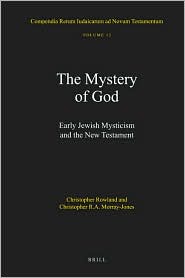
Rowland, "Things into Which Angels Long to Look"


Christopher Rowland, “Things into Which Angels Long to Look: Approaching Mysticism from the Perspective of the New Testament and the Jewish Apocalypses,” in Christopher Rowland and Christopher R. A. Morray-Jones, The Mystery of God: Early Jewish Mysticism and the New Testament (CRINT, vol. 12; Leiden and Boston: Brill, 2009), pp. 1-216.

In this study Christopher Rowland provides an outstanding survey of apocalypticism in the New Testament (NT). Rowland is to be commended for presenting a thorough argument in favor of the permeation of apocalypticism in New Testament theology. Instead of a limited focus on apocalyptic eschatology, Rowland capitalizes on the theme of the volume by analyzing apocalypticism in its “mystical” aspects. Following Hengel’s definition of apocalypticism as the search for “higher wisdom through revelation,” Rowland is keen to highlight visionary experience(s) and developed angelological and merkavah themes. Thus Rowland seeks to establish the apocalyptic origins of Christianity (á là Schweitzer) by conceptualizing apocalypticism along its (Jewish) mystical axis.

Friday, March 26, 2010

Atheist Delusions


I try to read as much of David Bentley Hart's work as I can. He is about the finest public Christian theologian I have read. Since I have taken back up with historical studies, I have little time for works of theology. But this is one I could not resist. In Atheist Delusions, Hart takes on the so-called New Atheists and their popular proclamations and pontifications.

The book is arranged in four parts. In part one (Faith, Reason, and Freedom: A View from the Present) Hart provides his interpretation of the current cultural situation that underlies the popularity of the "New Atheists." The first chapter outlines what Hart calls the "Gospel of Unbelief," and stages a first assault upon the incredible works of Dawkins, Dennett and Sam Harris in particular. In his initial examination Hart postulates that the problem underlying not only these dilettantes, but other popular authors as well (e.g. Philip Pullman and Dan Brown), is a faulty and simplistic view of history that overemphasizes the virtues of the modern world and the vices of Christianity, and concomitantly underemphasizing the virtues of Christian civilization and the vices of modernity.

Friday, January 15, 2010

The Historical Jesus: Five Views


Ordinarily I find these 'four views' or 'five views' kind of books a little contrived. Usually published by evangelical publishers and edited by evangelical editors, I think they are intended to show the superiority of the evangelical position. But this volume comprises a nice cross-section of current historical Jesus research.

The introduction to the volume is judicious and offers the basic background to historical Jesus research. The chapters that follow are essays by five scholars (Robert M. Price, John Dominic Crossan, Luke Timothy Johnson, James D. G. Dunn and Darrell Bock) who represent points along the spectrum of scholarly positions on the historical Jesus and the enterprise of studying the historical figure of Jesus. The volume does not disappoint expectations since the arrangement of the essays suggests a graded progression from the most radically revisionist to the most traditional portrait of Jesus. In spite of the clearly chosen arrangement, the essays each provide a snapshot of major voices in historical Jesus scholarship.

Sunday, December 27, 2009

Stark, Statistics, and the Early Church

In Cities of God (New York: HarperCollins, 2006), popular sociologist Rodney Stark attempts to bring quantitative, statistical analysis to bear on the study of the history of early Christian expansion. The description of the 'triumph' of Christianity, Stark argues, is incomplete, indeed unscientific, without the utilization of quantitative methods. "A major purpose of this book," writes Stark, "is to demonstrate that quantitative methods can help to resolve many debates about early church history" (22). He explains the book attempts "to identify adequate, quantifiable indicators of key concepts and then to properly test important hypotheses" (22, emphasis original). In so doing, the chapters of the book "will attempt to place the rise of Christianity within the appropriate social and cultural contexts, but they will do so in a more fully social scientific way than as ever been attempted" (22). Although the book is a provocative protreptic exercise, the book ultimately fails to convince because the author has not understood the pitfalls of the field he attempts to address.

Wednesday, November 18, 2009

Define Irony

iro-ny... 3 a (1): incongruity between the actual result of a sequence of events and the normal or expected result (2): an event or result marked by such incongruity.

So as I was walking from the bookstore to class, I saw a man at the end of the courtyard giving out books. Since I am a sucker for free books, I decided to walk in that direction. As I was approaching the vicinity of the gentleman I thought to myself, "Well, if it's another Bible, I'll pass--I've got plenty of those as it is!" As I drew nearer, the man thrust a handsome paperback my way and said "Origin of Species. One hundred fiftieth anniversary." "Well," said I, "I've already got one, but why not?" The evolutionists are handing out their Bibles now, I thought. As I walked away with my new copy of Darwin's classic I noticed something unusual, however, about this copy. "Introduction by Ray Comfort." Ray Comfort, Ray Comfort. I'm sure I know that name from somewhere. That right! He's the guy who wrote the very popular book on evangelism, Hell's Best Kept Secret. WHAAA? He wrote an introduction for Darwin's Origin of Species, and is encouraging people to hand out the book to college kids? Define irony.

So I opened the book to the epigraphs, all of them about free enquiry and education. Alongside quotes by Darwin, Scopes, and W. R. Thompson, is this representative nugget from some survey (which we are told was agreed upon by 84% of college graduates): "Teachers and students should have the academic freedom to discuss both the strengths and weaknesses of evolution as a scientific theory." Ok. So this is about not censoring Darwin. But wait, from a Christian evangelist?

So I opened the book further to the introduction and began reading. After a brief outline of Darwin's life and the very basic contours of the argument of the book, Comfort gradually offers a series of critiques of Darwin's work. He begins with soft criticism based on DNA mapping, which Darwin could not have possibly known about. The criticism raises in pitch with the discussion of transitional forms and the so-called missing link between humans and chimpanzees. Swiftly the discussion moves toward advocating for (you might have guessed by now) an Intelligent Designer. The slippery slope gets even more slippery when Comfort starts "revealing" the racism and sexism of social Darwinism, and reaches a climax with Adolf Hitler's affinity for Darwin (the heading for that section: "His Famous Student"). Comfort scales the rhetoric back a bit and comforts his audience by reminding them that Darwin was not, after all, an atheist (implied: so you shouldn't be, either). He empathizes: "So if I was [sic] an atheist, I would see that I have an intellectual dilemma." It's ok. You're a poor, misguided atheist. Let me explain something that makes more logical sense. Naturally, he then proceeds to outline an evangelical message, topping it all of with an altar-call: "To receive the gift of eternal life, you must repent of your sins (turn from them), and put on the Lord Jesus Christ as you would put on a parachute--trusting in Him alone for your salvation. ...Do it right now because you don't know when you will take that leap through the door of death. Confess your sins to God, put your trust in Jesus to save you, and you will pass from death to life. You have God's promise on it."

Now, I think all of this is basically correct. But I seriously doubt this amounts to a more logical frame of mind. How do you define irony? Well, expecting to receive a Bible, but then actually receiving (what is often considered) an atheist's bible--and that book actually ends up quoting the Bible. Yeah. I'd say that pretty well covers it.

So if you haven't read Darwin yet, keep your eyes out for people giving away free books. It might not be what you expect, but irony is meant to be enjoyed.

Tuesday, November 17, 2009

Imperial Christianity?

I just looked back at my earlier post about "Constantinian" Christianity. In my comment to a reader, I lamented the construction of a sort of edifice of "anti-imperial" Christianity (popular in post-Evangelical and emerging circles). The important part of that comment is the parenthetical remark that wonders what that means in our current context.

So, here's a question. How do we live a kind of Christianity that is subversive of Empire if there is no emperor? I mean, an Empire is a political system ostensibly directed and in some ways constituted by the necessary component of the emperor. Without an emperor what do we have? Either anarchy (which is certainly not the case currently--indeed, even the early church couldn't countenance anarchy [I shouldn't have to mention the authority of the apostles in the early church]), or some other form of government--oligarchy, democracy, etc. Now, we Americans live in a democratic republic of sorts, not an actual empire. So, it seems, the language of Empire is extended to the so-called 1st-world West--the colonial powers. But the late-capitalist system (that a great many of us agree is a problem) has grown beyond such powers and has taken on a trans-national character. In other words, if it is an empire, it is an empire without a (visible) emperor. Indeed, it seems to be anarchy--or perhaps better, feudalism between competing corporations. So what are we to do? We cannot assassinate the emperor. I'm wondering if a better solution would be to use the political system against the (currently) unjust economic order. Instead of conflating the two in America, I think Christians might do well to recognize that the political sphere is still malleable (as I think, ironically, the Tea Party has shown), and this is a remarkably fertile place to stage resistance to this faceless "empire." I'm not saying it would be easy. I'm saying it might be more responsible. "Shoplifters of the world, unite and take over."

Monday, November 16, 2009

What's all the fuss about?

So, about a week ago the Vatican released the official Apostolic Constitution Anglicanorum Coetibus. The annoucement of this AC caused a great deal of consternation and much ire all over the blogosphere. I'm not entirely sure why. Now, Hans Kueng has offered what I think is probably the best critical comments, but even his take is only one side of the story. Reading the actual text, I find very little to be critical of. As a previous blogger (sorry, lost the link) continues to remind people--the Pope is (Roman) Catholic. We should not be surprised if he does things or says things that generally are in accord with Roman doctrine. Sure, he doesn't have the same finesse as JPII, but B16 is not the devil, or even an evil man, so far as I can tell. He's the shepherd of the largest Christian communion, and in accord with Roman doctrine he also sees himself as the vicar of Christ, the shepherd of the world. Not saying he's correct to think so, but I am saying we probably shouldn't be surprised if he acts on that notion.

All (constructive) thoughts welcome.

DeConick vs. National Geographic: Round 2?

This post is very good. April DeConick famously protested against the characterization, translation, and publicization of the Gospel of Judas a couple of years back. Now she's concerned about their take on the Apocalypse of Gabriel.

I'll try to add background links when I have some more time.